Greater productivity by looking at the entire process
Small and medium-sized CNC manufacturers are under intense pressure: components are becoming more complex, the number of variants is increasing, delivery times remain tight, and skilled workers must be deployed in ways that maximize value creation. This is precisely where manufacturing using Turn & Mill technology and automation solutions come into play. However, their greatest benefit does not stem solely from a new machine, but from a reimagined process chain. The key question is: Which machining steps can be combined in such a way that there is less setup, fewer re-clamping operations, and more productive manufacturing?
Process integration reduces friction losses
In many manufacturing processes, components still pass through multiple machines and stations: turning, milling, drilling, measuring, re-clamping, and re-alignment. Each step may be technically justified. Taken together, however, they result in setup costs, waiting times, transport distances, intermediate storage, and additional opportunities for error. Turn & Mill machines or 5-axis machining centers with FD integration combine turning and milling operations in a single work area. Depending on the application, additional processes such as drilling, threading, gear cutting, grinding, or in-process measurement can be integrated. The goal is complete machining within a single work area.
Schwarzer GmbH of Schloß Holte-Stukenbrock confirms that this approach is successful in practice. Using a CLX 450 TC, the company has consolidated the production of complex components into a single workcell. Previously, the process required three machines. The 6-sided complete machining process includes milling, turning, and engraving the workpieces. It mills, turns, and engraves. Measurements are also taken during the process. “In case of deviations, the machine automatically corrects the program,” adds Managing Director Thorsten Schwarzer. Furthermore, setup time has been drastically reduced. Thanks to the B-axis, we need fewer tools per workpiece compared to a turret lathe. Thanks to the tool magazine, we have many more tools at our disposal. This is ideal for us as a contract manufacturer with many changing parts. We’re no longer setting up—we’re already turning!”
This experience clearly demonstrates why DMG MORI views process integration as a key lever for reducing setup time, idle time, and clamping errors, and for shortening cycle times. This approach is particularly relevant for job shops and medium-sized CNC companies. This is because unused capacity often lies not in spindle time, but in process interruptions: in retooling, searching, waiting, transporting, and coordinating.
Automation extends runtime
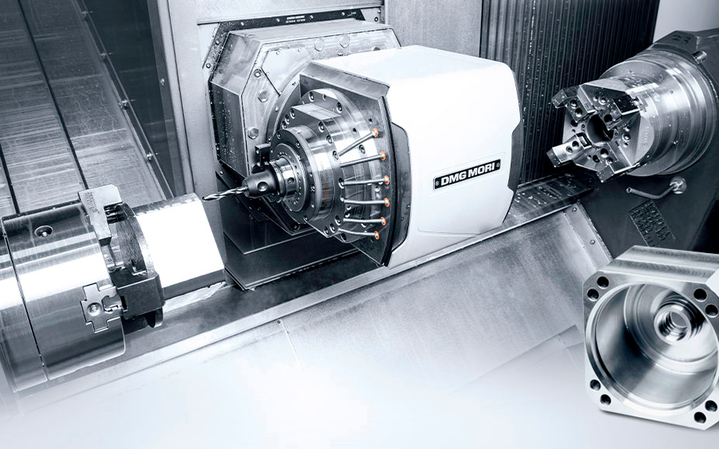
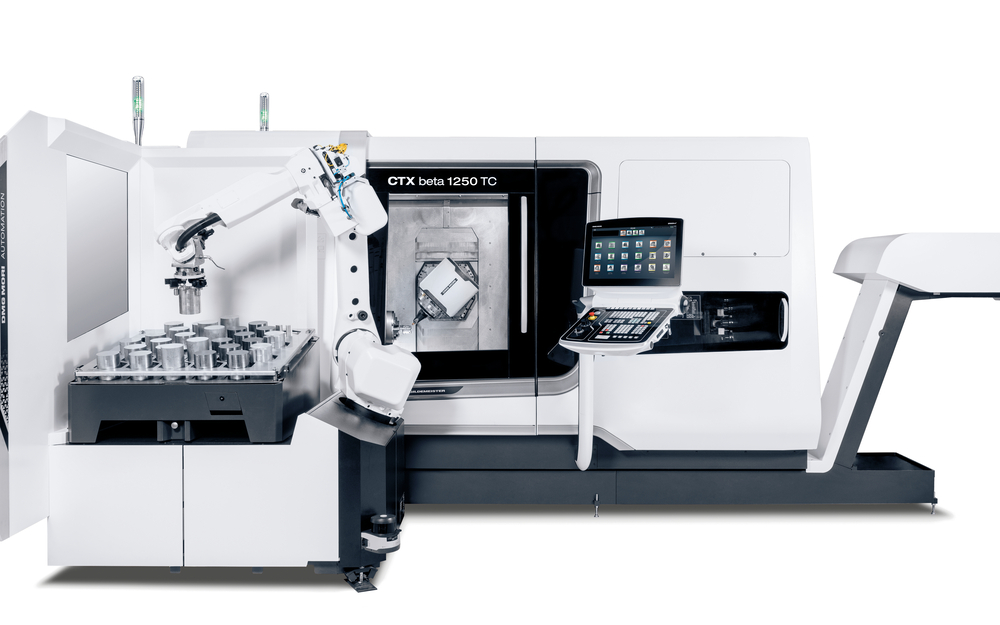
While Turn & Mill machines consolidate process steps within the work area, thereby reducing cycle times, automation solutions eliminate manual intervention in the actual machining process. The combination of these two approaches results in more productive overall processes. However, the first step does not have to be a fully automated production line. For many companies, workpiece handling is the pragmatic first step. This was also the case at WILHELM BAHMÜLLER Maschinenbau Präzisionswerkzeuge GmbH in Plüderhausen. Two CTX 1250 beta TC machines were already in use there when the company decided to add another turn & mill machine with automated handling. Here, too, the CLX 450 TC was the ideal choice. Workpiece handling is handled by a Robo2Go. Another Robo2Go was retrofitted to one of the two CTX beta 1250 TC machines. Above all, the ease of training convinced Hans Binder, Head of the Precision Tools Division: “The system is self-explanatory and intuitive because it guides the user through the process.”
Solutions like the Robo2Go can handle loading and unloading, thereby enabling additional productive runtime—for example, in the evenings, at night, on weekends, or alongside daily operations. However, the key point is this: automation does not replace process stability. It makes better use of stable processes. Raw parts, clamping devices, gripability, part positioning, chips, coolant, tool life, and response to malfunctions must all be under control. Only then does automation become a reliable lever for productivity.
Automation Retrofit for Increased Productivity on Existing Machines
Solutions like the Robo2Go are a good example of automation retrofitting. In many cases, DMG MORI can retrofit customers’ existing machines with an automation solution that meets new production requirements. This allows for a rapid increase in capacity and helps alleviate labor shortages. Automation solutions for handling workpieces and pallets create additional productive runtime overnight or alongside daily operations. The advantage of retrofitting is that the automation leverages well-established and stable processes, proving to be a reliable productivity driver with a short payback period.
Is Turn & Mill suitable for mixed components?
Before making the investment, it is therefore essential to analyze your own range of parts. Of particular interest are recurring part families that involve multiple machining technologies, multiple setups, high requirements for positional and geometric accuracy, or significant setup and planning efforts. However, not every complex part is automatically a good candidate for turn-mill machining. If clamping surfaces are unclear, raw parts vary significantly, tools remain difficult to access, or expertise in CAM and simulation is insufficient, complete machining can create additional complexity. The benefits arise where the component, clamping strategy, programming, quality assurance, and operator expertise all align.
Workpiece handling, pallet handling, or a production cell?
Automated manufacturing can be implemented in various ways depending on the component and machine. Robot-based workpiece handling systems, such as the Robo2Go models, are positioned in front of a lathe or milling machine, where they handle the loading and unloading of parts. The compact Robo2Go Open can be set up in just a few minutes wherever it is needed. In the case of the Robo2Go Max, the workpiece weight can be up to 115 kg. The WH Cell allows loading via a side door. This compact solution with high workpiece storage density enables highly productive manufacturing of large production runs, particularly for small parts.
On milling machines, pallet handling systems offer another option for automation. They load the machine with clamping systems or fixtures, providing users with a high degree of flexibility. A pallet storage system can accommodate different jobs, and individual pallets can be loaded with various parts on clamping towers. Based on these automation solutions, entire production cells are also conceivable—for example, cells that connect multiple machines via a MATRIS system or in which a robot loads the pallet handling system on a milling machine.
From Machine Capacity to Process Capability
The most important lesson for small and medium-sized CNC companies is this: The journey toward Machining Transformation (MX) does not begin with machine configuration. It begins with the reality of your own manufacturing operations.
Which parts currently require the most reclamping?
Which downtime can be avoided?
Which processes are stable enough for automated production?
What data demonstrates the benefits?
Anyone who answers these questions clearly will not find a one-size-fits-all solution. But they will find the next logical step: from individual machines to complete machining, from manual intervention to reliable automation, and from mere machine capacity to true process capability.