Cutting-edge Ultrasonic Technology for Research and Teaching
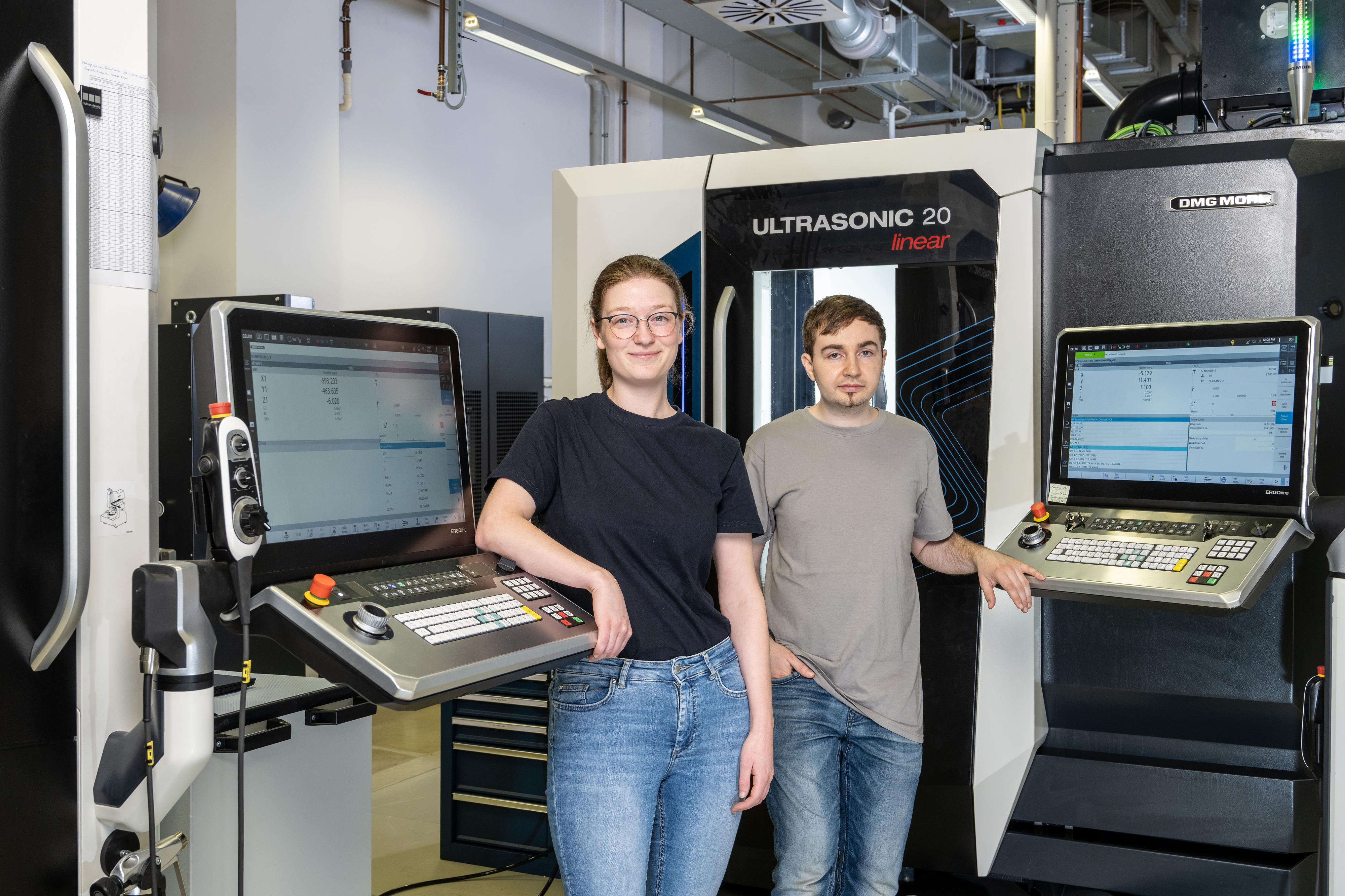
Since its founding in 1991, Ernst-Abbe-Hochschule Jena has combined practice-oriented teaching with application-driven research. Approximately 50 bachelor’s and master’s degree programs in engineering, business, social sciences and health sciences provide a modern academic environment. The university is also recognized as Thuringia’s most research-intensive university of applied sciences. A prime example is the ULTRASONIC Competence Center, established in 2025 within the Department of Science & Technology. As part of a cooperation agreement, DMG MORI is providing two loan machines: an ULTRASONIC 20 linear 3. Generation and an ULTRASONIC 60. With these, the center is now equipped with the latest cutting-edge technology. The center aims to further exploit the potential of ultrasonics, as well as to test and optimize practical use cases.
“The machining of hard and brittle materials such as fused silica or glass ceramic is becoming increasingly important, particularly in forward-looking industries like the semiconductor, laser and optoelectronics industries,” explains Sebastian Henkel, research assistant and doctoral candidate in laser and optical technologies. Companies must manufacture components with complex geometries and perfect surfaces in a productive and reliable manner. Ultrasonic-assisted grinding has emerged as a suitable method in this field. This technology is being continuously refined at the Ernst Abbe University of Applied Sciences in Jena.
Challenge
- Machining hard and brittle materials such as fused silica and glass ceramics with high precision
- Producing demanding freeform surfaces that require 5-axis simultaneous machining
- Reducing extensive post-processing steps such as polishing
- Achieving high material removal rates while maintaining thin-walled and stable component geometries
Added Value
- Gentle and highly precise machining of hard and brittle materials
- Reduced chipping and improved surface quality
- Lower tool wear, resulting in economic benefits
- Strong collaboration between academia, industry, and technology partners
- Practical research results that can be rapidly transferred into industrial applications
Solution
- Use of DMG MORI's ULTRASONIC 20 linear 3. Generation and ULTRASONIC 60 Precision
- Ultrasonic-assisted milling and grinding with superimposed longitudinal tool vibrations
- 5-axis simultaneous machining for complex freeform surfaces
- Research and optimization of fine and ultra-fine grinding processes for advanced materials
Results
- Significant reduction of downstream polishing requirements
- Higher surface quality through fine and ultra-fine grinding
- Enhanced teaching, research, doctoral projects, and student training opportunities
- Increased regional visibility and knowledge transfer in ultrasonic technology
- Creation of a competence center showcasing advanced ultrasonic machining solutions for industry partners and DMG MORI customers.