Reliable series production of mobility components
The Mobility sector stands for productivity, precision and process stability like almost no other industry. For manufacturers and their suppliers, it is still a matter of producing complex components economically with minimal tolerances and reproducible quality. Horizontal machining has always played a key role here, as it has long since proven itself as the backbone of highly automated series production. Many central components from the automotive industry are predestined for machining on horizontal machine concepts: cylinder blocks, cylinder heads or transmission housings may become less important in the long term, but they are still prime examples of horizontal machining. The same also applies to components in electromobility with regard to the various housings for motors or power electronics. Due to the high importance of horizontal machine concepts, DMG MORI has built up a wide range in this discipline - from the NHX series for 4-sided machining to the INH models and the DMU 65 H monoBLOCK, each for 5-axis machining.
Perfect chip removal and multi-sided machining
The main advantage of horizontal milling and drilling is that chips fall downwards unhindered and can be easily removed. Especially with aluminum, grey cast iron and vermicular graphite cast iron components, which are widely used in the automotive industry, the horizontal alignment of the spindle minimizes chip accumulation in the deep pockets and holes of complex workpieces. This makes machining more reliable and also increases tool life. This results in a more reliable and economical production process.
The ability to machine complex components from several sides in a single clamping operation also contributes to efficient and productive manufacturing, as it minimizes reclamping processes and thus non-productive times. On the other hand, it facilitates the machining of components with low position and reference tolerances. Cylinder blocks and heads, for example, have numerous bores, sealing surfaces and threads that require a highly accurate shape and position tolerance on the different sides.
For smaller workpieces, multi-sided machining also allows the use of clamping towers that are loaded from four sides - a major advantage in series production. The design and the resulting design advantages therefore give horizontal machining centers strategic added value compared to vertical machine concepts.
Maximum machine rigidity for roughing or finishing
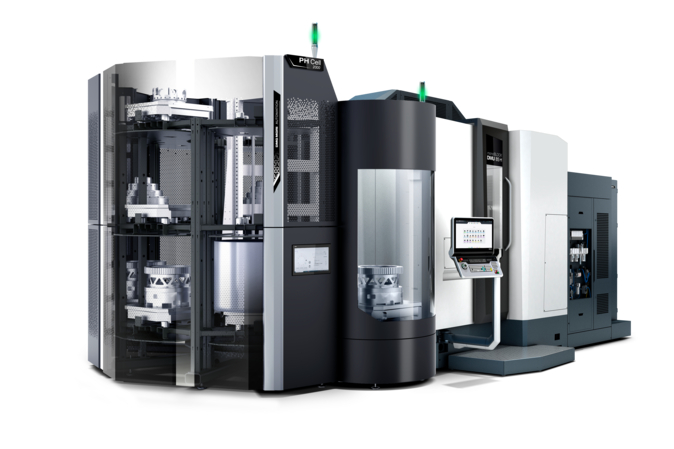
Another aspect that speaks in favor of horizontal machining is machine rigidity. Many models in this area are designed for high machining volumes. The high stability is particularly beneficial for large castings with numerous flat surfaces and deep bores. At the same time, the stable design ensures precise manufacturing with high repeat accuracy. This means that even the most demanding bores and fits can be achieved with consistent quality across large series. Ultimately, this is a basic requirement because quality standards in the mobility sector are naturally particularly high due to the numerous safety-relevant components.
Increased productivity through automated pallet handling
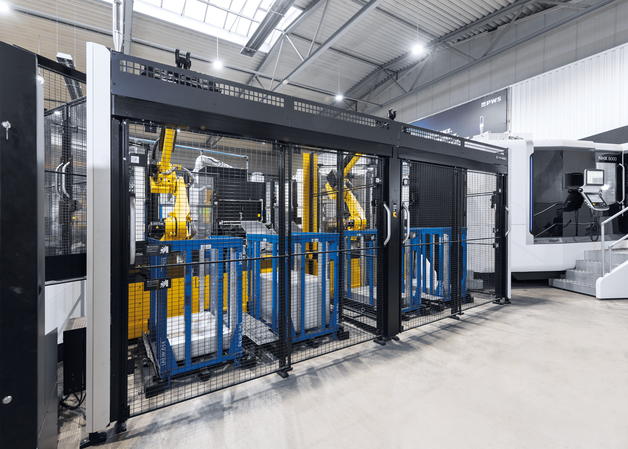
Beyond their design advantages, horizontal machining centers prove to be the ideal basis for automated production. Extensive pallet pools such as DMG MORI's LPP solutions enable efficient series production. Other process steps can also be integrated here, such as a laser station that marks the components for further tracking. The same applies to the flexible MATRIS system, a robot-based workpiece handling system for individual automation requirements. Fully automated manufacturing solutions such as these give users the opportunity to set up new orders in parallel with main production time, thereby maximizing spindle running time. Driverless transport systems – DMG MORI uses its AMR models here – can also handle tools or perform chip disposal.
A well-thought-out automation approach ultimately preserves production flexibility. This is because the industry has been undergoing a shift away from conventional drives toward hybrid and electric vehicle technologies for several years now. In this transformation process, it is important to design production systems in such a way that they can reflect technological changes without losing efficiency. Horizontal machining centers offer a decisive advantage here: they combine series productivity with structural adaptability. New component geometries, modified clamping concepts, or changed quantities can be integrated into existing system architectures without having to rebuild entire production lines.
Partner for sustainable transformation
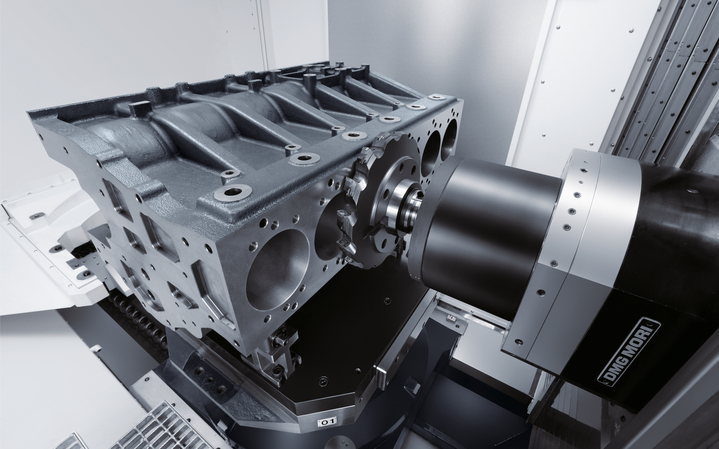
With its extensive product portfolio, DMG MORI sees itself as a comprehensive solution provider in the mobility sector. The machine tool manufacturer combines suitable horizontal machining centers with the right automation and numerous digital solutions that enable end-to-end networked production with intelligent monitoring and documentation. This philosophy supports sustainable transformation and creates future-proof structures for competitive manufacturing in the mobility sector.